
A hundred dollars doesn’t buy much these days.
A decent dinner for two can swallow most of it. A trip to the grocery store can make it disappear before you’ve even reached the frozen food aisle. And if you’ve ever hired someone to build a website, design a logo, or write marketing copy, you know that $100 traditionally hasn’t gotten you very far.
But what if you took that same $100, gave yourself five days, and challenged yourself to build a real online business using artificial intelligence?
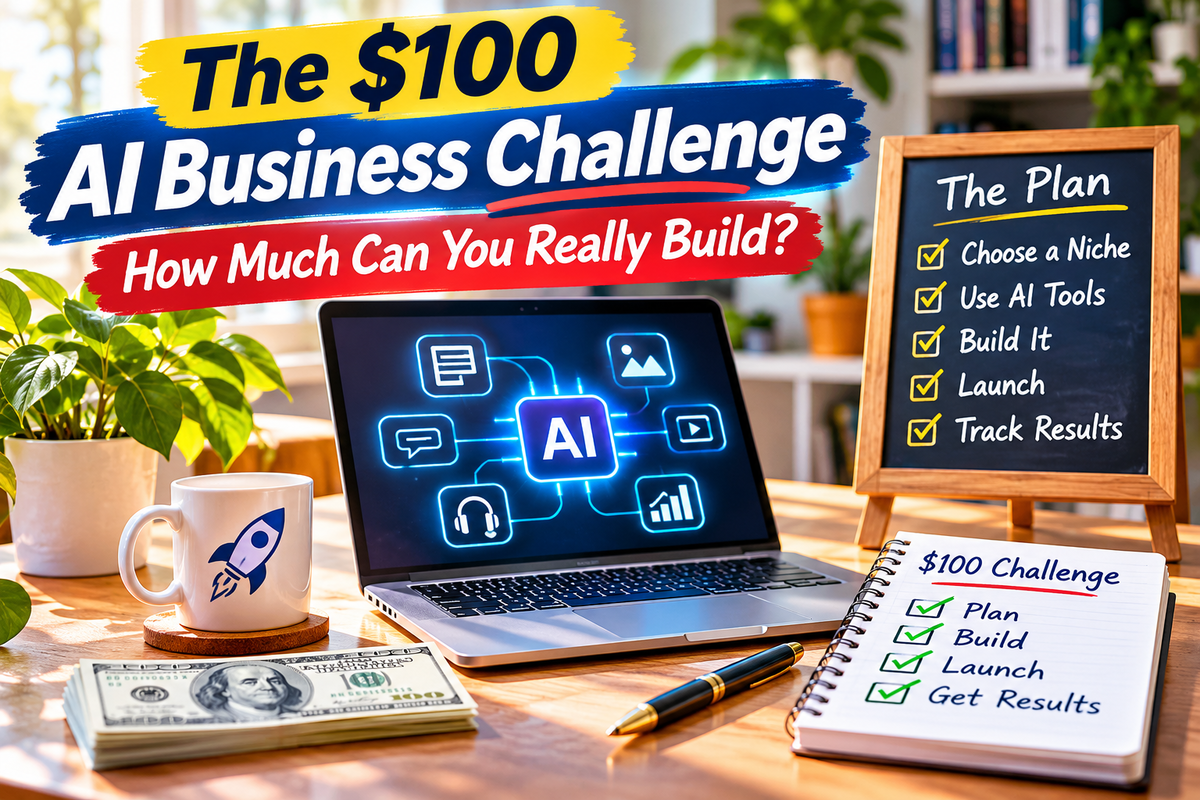
Not a billion-dollar startup. Not a revolutionary app that changes civilization. Just a small, functional business with something useful to offer, a professional online presence, and a realistic path toward earning its first dollar.
Could you actually pull it off?
A few years ago, the answer would have been considerably more complicated. Today, with affordable AI tools handling tasks that once required specialized skills, the experiment becomes surprisingly interesting.
So let’s put that hundred dollars to work.
First, Let’s Define What Counts as a Business
There’s an important distinction between building a business and building something that looks like a business.
You can generate a beautiful logo in five minutes. You can ask AI to write an impressive mission statement. You can even create a website that makes your brand-new operation look like it’s been around since 2012.
None of those things means you have a business.
For our challenge, we’re going to establish five requirements.
By the end of five days, we want:
- A clearly defined customer with a specific problem.
- A product or service that solves that problem.
- A functioning website where people can learn about the offer.
- A way for interested customers to contact us or make a purchase.
- A practical plan for attracting our first potential customers.
Notice what’s missing?
We haven’t required a sale.
That’s intentional. You can build an offer in five days, but you can’t force someone to buy it. Actual sales depend on demand, trust, timing, competition, and whether your offer is genuinely useful.
Our goal is to build something that could generate revenue, then begin testing whether people actually want it.
The $100 Budget: Where Every Dollar Goes
One of the biggest mistakes new entrepreneurs make is spending money on things that feel productive but don’t bring them any closer to a customer.
Fancy branding packages. Premium software subscriptions. Elaborate websites with fourteen pages nobody visits.
We’re going to keep things lean.
Here’s a sample budget for the experiment.
| Expense | Budget |
|---|---|
| Domain name | $15 |
| Website hosting or publishing | $20 |
| AI tools (free tiers initially) | $0 |
| Design and graphics tools (free tiers) | $0 |
| Payment processing setup | $0 |
| Small marketing experiment | $40 |
| Emergency reserve | $25 |
| Total | $100 |
These are planning allowances, not guaranteed vendor prices. Domain and hosting costs vary, and payment processors typically deduct transaction fees when sales occur.
You might spend less than this if you use free publishing tools. You might also decide that the $40 marketing budget is better spent after you’ve validated your offer.
The most important rule is simple: Don’t spend money merely because you’ve allocated it.
Every dollar should serve a purpose.
Day 1: Find a Problem Worth Solving
This is where AI can be incredibly useful, but also dangerously persuasive.
Ask an AI assistant for business ideas, and it will happily produce fifty of them before you’ve finished your coffee.
The problem is that an idea isn’t necessarily an opportunity.
Instead of asking, “What business should I start?” try asking something more specific:
What are ten frustrating, time-consuming problems faced by independent real estate agents that could be solved with a simple digital service?
Now we’re getting somewhere.
You could explore dozens of markets: pet groomers, tutors, local contractors, freelance writers, online sellers, or busy parents.
For our experiment, let’s choose a fictional business offering professional social media content packages for independent home-service businesses.
Think plumbers, electricians, landscapers, and cleaning companies.
Many small business owners understand that they should post regularly on social media. They just don’t have the time, ideas, or patience to do it.
Our proposed service will create ready-to-use social media posts tailored to their business.
AI can help draft the content and generate creative concepts. A human still needs to check accuracy, remove generic fluff, and make sure the posts actually sound like the business.
Before committing, we should investigate whether businesses already pay for similar services and whether our target customers express frustration with maintaining their social media presence.
Look at competitor websites, customer discussions, and service marketplaces. Better yet, talk directly to a few business owners.
The goal of Day 1 isn’t to prove your idea is brilliant. It’s to find enough evidence that the problem is real.
Day 2: Build Something You Can Actually Sell
Now comes the fun part.
Instead of spending weeks developing an elaborate service catalog, we’ll create one straightforward offer.
Let’s call it the Small Business Social Starter Pack.
For $49, a customer receives:
- Ten customized social media post captions.
- Five coordinated graphics.
- A suggested two-week posting schedule.
- One round of reasonable revisions.
The deliverables are simple enough to produce with affordable tools, but potentially valuable to a business owner who would otherwise spend several hours creating them.
AI can draft caption ideas, suggest seasonal topics, and help brainstorm visual concepts.
A free design tool can handle graphics.
A basic spreadsheet or document can organize the posting schedule.
The real work is in personalization.
A landscaping company’s social posts shouldn’t sound like they came from the same template as a dentist’s office. The content needs to reflect the customer’s actual services, location, audience, and personality.
And AI-generated claims about services, discounts, customer experiences, or results must be verified before anything is delivered.
Here’s another important consideration: at $49, you need to watch how much time each order takes.
If creating the package requires six hours of manual work, you’ve built yourself a very low-paying job.
If AI-assisted drafting and a repeatable production process help you deliver quality work in roughly an hour or two, the economics become more interesting.
That’s something you’ll need to measure rather than assume.
Day 3: Give Your Business a Home on the Internet
This is the day when your experiment starts feeling real.
You need a place where potential customers can understand what you offer and decide whether to contact you.
Fortunately, you don’t need an enormous website.
A single well-designed page can do the job.
It should answer a few basic questions:
What do you offer? Ready-to-use social media content packages for small service businesses.
Who is it for? Busy business owners who want to stay visible online without creating every post themselves.
What does it cost? $49 for the starter package.
What happens next? Customers submit their business information, you prepare the package, and they receive their content within an agreed delivery window.
Add a couple of clearly labeled sample posts, a simple contact form, and a straightforward ordering process.
AI can help write your page copy, organize the layout, and suggest improvements.
You can use an AI-assisted website builder, a simple WordPress installation, or another affordable publishing platform.
Just don’t let the technology become the project.
It’s remarkably easy to spend four hours adjusting button colors while avoiding the uncomfortable task of finding customers.
A website is a tool. The business happens when people use it.
Day 4: Find Out Whether Anyone Cares
This is where the challenge gets interesting.
You’ve got a service. You’ve got a website. You’ve even got a price.
Now comes the question that separates entrepreneurship from a weekend design project:
Will anyone actually pay for this?
You could spend your entire $40 marketing allowance on advertising, but I wouldn’t rush to do that.
Start with direct research and thoughtful outreach.
Identify ten or fifteen businesses that appear to have an inconsistent social media presence.
Study their websites and public social accounts. Look for opportunities where your service might genuinely help.
Then send a short, personalized message.
Something like:
“Hi, I came across your landscaping business and noticed you have some great project photos. I help local service businesses turn material like that into ready-to-post social media content. I put together a couple of sample ideas for your business if you’d like to take a look.”
No exaggerated promises. No pretending you’ve worked with companies you haven’t. No mass-produced messages that begin with “Dear Esteemed Business Owner.”
And be respectful of platform rules, email marketing requirements, and people’s preferences about unsolicited contact.
You could also post helpful examples in relevant business communities where promotion is permitted.
Perhaps share three ideas for social posts that a plumbing company could use during winter.
The point is to demonstrate that you understand a real problem and can offer something useful.
You might get a response. You might get ignored.
Either outcome teaches you something.
Day 5: Measure What You Built, Not What You Imagined
By the fifth day, you’ll probably be tempted to judge the challenge by one number:
How much money did I make?
That’s understandable, but it’s not the only useful measure.
Suppose you finish the week with a functioning website, three sample packages, fifteen personalized outreach messages, four replies, and one business owner interested in discussing an order.
You haven’t necessarily built a profitable business.
But you’ve created something tangible, and you’ve started collecting evidence about whether it could work.
Now consider a different outcome.
You spend the week designing a beautiful website, generate 100 social media graphics, and write a 40-page business plan.
But you never contact a potential customer.
Which experiment taught you more?
Probably the first.
The real purpose of this challenge is to move from assumptions to evidence.
Track how many people you contact, how many respond, what objections they raise, how long fulfillment takes, and whether anyone is willing to pay your proposed price.
If the response is weak, don’t automatically conclude that entrepreneurship isn’t for you.
Maybe the offer is too generic. Maybe the target audience isn’t right. Maybe the price is wrong. Or maybe you simply haven’t reached enough qualified prospects to learn anything meaningful.
The next step is to improve the experiment, not declare victory or defeat prematurely.
What AI Actually Changes About Starting a Business
Here’s what makes this experiment different from trying the same thing ten years ago.
AI reduces the amount of specialized work you need to do before testing an idea.
You no longer have to begin with a blank page every time you need marketing copy.
You can create design concepts without mastering complicated graphics software.
You can brainstorm customer questions, organize workflows, draft proposals, and troubleshoot technical problems with an assistant available whenever you need it.
That’s a meaningful advantage.
But AI doesn’t eliminate the difficult parts of business.
It can’t guarantee that people want your offer.
It can’t make an untrustworthy business trustworthy.
It can’t replace understanding your customers.
And it certainly can’t promise that your first $100 investment will turn into $1,000 by next Friday.
What it can do is make the process of testing an idea faster, less expensive, and more accessible.
That’s where the real opportunity lies.
The Hidden Cost Nobody Talks About
There’s one expense we haven’t included in our $100 budget.
Your time.
Five days of focused effort could mean fifteen hours, twenty-five hours, or considerably more, depending on your experience.
If you’re already employed, raising a family, or managing other responsibilities, that time is valuable.
And while AI can accelerate many tasks, you’ll still spend time reviewing its work, learning tools, solving unexpected problems, and talking with potential customers.
That’s why I wouldn’t recommend starting five different AI businesses at once.
Pick one idea.
Build one clear offer.
Test it with one specific audience.
Then decide whether it deserves more attention.
The greatest advantage of starting small isn’t simply that you risk less money. It’s that you can discover what doesn’t work before investing months of your life in it.
So, How Much Can You Really Build With $100?
More than you might expect, and less than some enthusiastic internet videos would have you believe.
With a hundred dollars and a few focused days, you can potentially create a professional online presence, develop a legitimate service, build sample deliverables, establish a way to accept orders, and begin reaching real prospective customers.
That’s a meaningful accomplishment.
What you probably can’t do is create a reliable income stream, establish a loyal customer base, or prove long-term profitability in five days.
Those things require continued effort, feedback, and usually a fair amount of trial and error.
But here’s the part I find most interesting.
For years, one of the biggest barriers to starting a small online business was the cost of getting ready.
You needed a website. You needed design work. You needed marketing materials. You needed technical knowledge.
Today, many of those barriers are lower.
The bigger challenge is deciding what to build, finding people who genuinely need it, and being willing to put your idea in front of them.
And that leads to a question worth asking:
If $100 is enough to test a real business idea, what’s the one idea you’ve been putting off because you thought you needed more money to get started?

Godfrey Pafura shares practical tips, tools, and resources to help make building income online simpler and more approachable. Through this website, Godfrey provides helpful content and recommendations, including the Plug-In Profit Site, a system designed to help beginners get started online with a website, step-by-step training, and built-in income streams. Learn more about getting started with Plug-In Profit Site here.